Study title: Structural basis for RISC assembly of human Argonaute2
New research by Prof. Nakanishi and his team at The Ohio State University expands our understanding of how human Argonaute proteins process small RNA molecules to control gene expression. Building directly on their previous discoveries regarding AGO1, this new study shows that equivalent mutations in AGO2 cause the exact same mechanical defect, pointing to a universal mechanism.
Argonaute proteins (such as AGO1 and AGO2) help regulate gene activity in the cell. To do this, they must load a double-stranded RNA molecule consisting of a "guide" strand and a "passenger" strand. To become fully active, the protein must separate these strands and discard the passenger strand.
What did the researchers find?
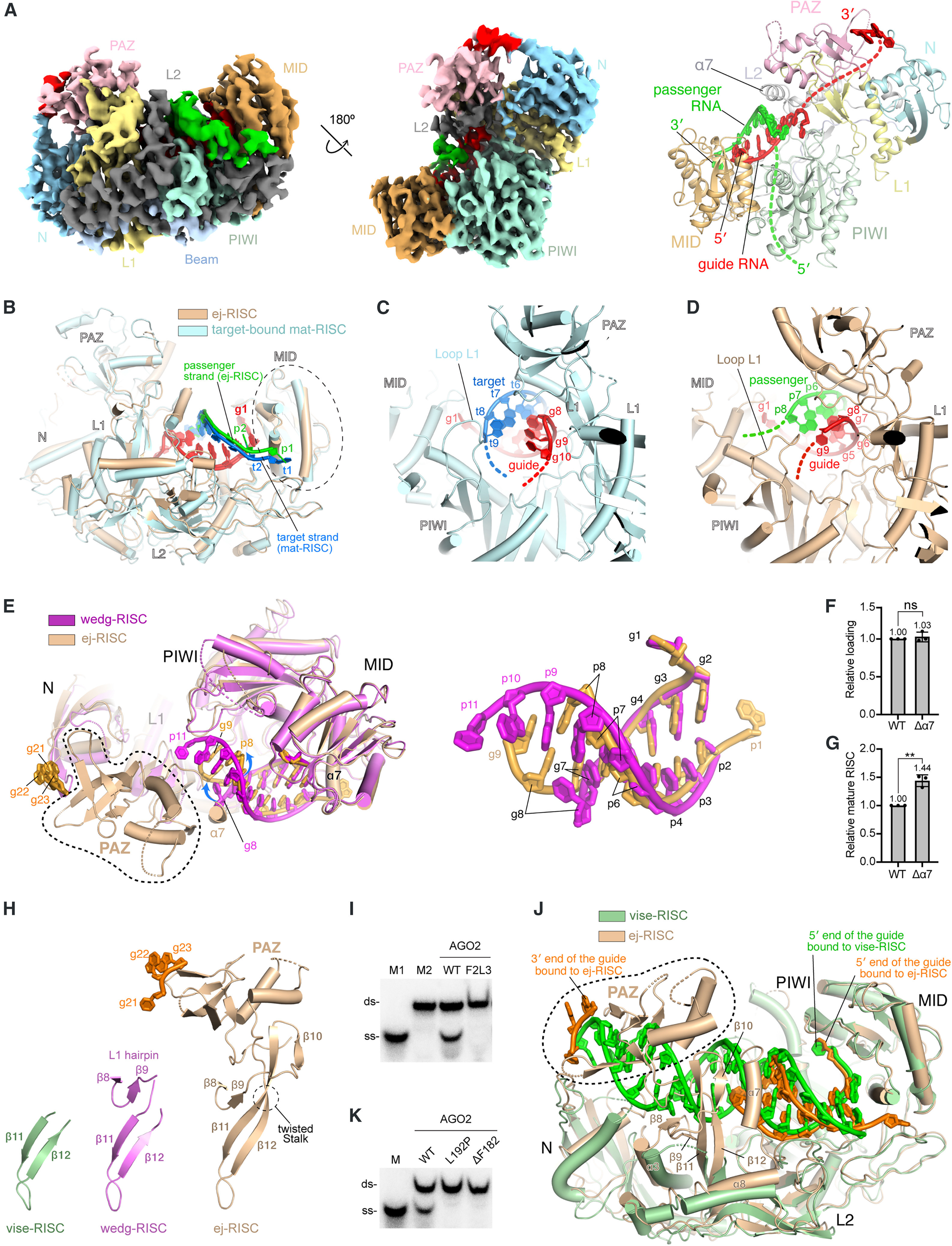
Using high-resolution imaging, the team mapped out the precise physical changes AGO2 undergoes during this assembly line. Crucially, they tested how specific disease-associated mutations in sections called the L1 hairpin and the Stalk disrupt this process:
The Stalk Wedge Mechanism: The researchers discovered that during the assembly process, two regions of the protein—the L1 hairpin and the Stalk—rigidify and move together to form a physical molecular "wedge". This wedge actively pushes itself between the two RNA strands, forcing them apart so the passenger strand can be peeled away.
Link to prior AGO1 findings: In their previous work, the lab discovered that two specific mutations associated with AGO1 syndrome (delF180 and L190P) severely impair passenger strand ejection. In this study, they engineered the exact equivalent mutations into AGO2 (delF182 and L192P) to see if the defect behaves the same way.
Normal RNA loading: They found that these mutated AGO2 proteins are perfectly capable of capturing and loading the double-stranded RNA molecule, matching the efficiency of the healthy protein.
Failed passenger ejection: However, because the mutations alter the structural integrity of the L1 hairpin and Stalk, the AGO2 protein completely fails to eject the passenger strand.
Stalled protein complexes: Because the passenger strand cannot be removed, the mutated protein becomes trapped halfway through the assembly process. This leaves it inactive and unable to perform its normal gene-silencing duties in the cell.
Why does this matter?
By proving that these mutations cause the exact same mechanical blockage in both AGO1 and AGO2, this study confirms a shared, consistent disease mechanism across different Argonaute proteins.
Knowing that the syndrome relies on this specific structural "jam" rather than a failure to bind RNA entirely provides researchers with a target for developing future therapeutic strategies aimed at resolving or bypassing the block.
References
Zhang et al., Structural basis for RISC assembly of human Argonaute2. Molecular Cell, 2026.